

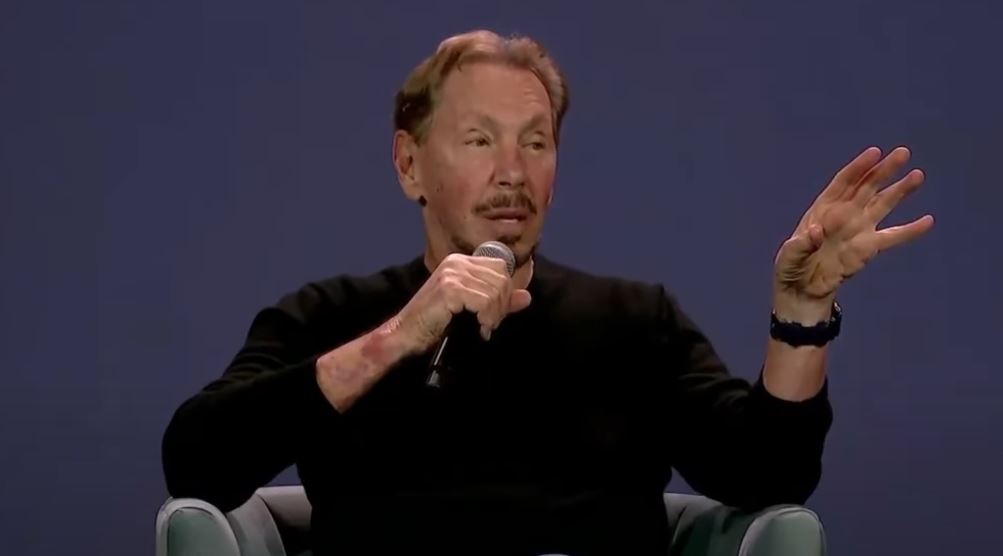
Larry Ellison’s wealth has grown to an unprecedented level, reaching $371.4 billion in 2025 and even reaching $393 billion during an unexpected spike in Oracle’s stock price. That put him momentarily ahead of Elon Musk, a feat that brought renewed interest to a man who has frequently favored strategy over show. Oracle’s leadership in enterprise software, a sizeable investment in Tesla, and an empire of luxury assets, including a whole Hawaiian island, are the foundation of his remarkably successful wealth.
Ellison’s rise from a humble Bronx childhood to leadership of one of the most valuable tech firms has always been a tale of audacious choices. Co-founded in 1977, Oracle first gained notoriety for database systems but has significantly increased its relevance by rapidly entering the cloud and artificial intelligence space. The company’s AI-driven expansion has been especially advantageous in recent days, doubling the value of its stock and propelling Ellison’s wealth to previously unheard-of heights. Although this metamorphosis is remarkably similar to Microsoft’s rebirth under Satya Nadella and Nvidia’s explosive growth under Jensen Huang, Ellison’s success is particularly exceptional due to his longevity as a leader.
| Category | Details |
|---|---|
| Full Name | Lawrence Joseph Ellison |
| Born | August 17, 1944 (Age 81), The Bronx, New York |
| Nationality | American |
| Occupation | Co-founder of Oracle; Executive Chairman & CTO |
| Estimated Net Worth | $371.4 billion (Forbes 2025); peaked at $393 billion (Bloomberg 2025) |
| Source of Wealth | Oracle (41% ownership), Tesla stake, real estate, investments |
| Education | University of Chicago (attended, no degree) |
| Major Assets | Oracle shares, Tesla stock, Island of Lanai (Hawaii), estates in California, Malibu, Lake Tahoe, Rhode Island, Palm Beach |
| Children | David Ellison (film producer), Megan Ellison (film producer) |
| Spouse | Jolin Zhu (m. 2023); previously Melanie Craft (2003–2010) |
| Known For | Building Oracle into a global software leader, bold real estate purchases, luxury lifestyle |
| Philanthropy | Pledged 95% of wealth, $200M to USC, $1.3B to Ellison Institute in Oxford |
His net worth increased by $89 billion in a single day in September 2025 as a result of Oracle’s earnings, the biggest gain ever made by an individual investor. This abrupt change demonstrated how valuations have changed due to the much faster adoption of AI, in addition to the volatility of tech fortunes. In contrast to Elon Musk, who thrives on bold claims, Ellison has opted for a more subdued but no less effective strategy. He establishes influence through perseverance rather than noise, demonstrating that patience and creativity can work in concert to create enduring wealth.
His $300 million purchase of the Hawaiian island of Lanai in 2012 is still regarded as one of the most daring individual investments of the modern era. It now functions as a combination of private retreat, luxury travel, and sustainable agriculture initiatives. Ellison has set an example for how extreme wealth can be surprisingly creative in tackling larger societal issues by making significant investments in conservation and renewable energy. Although it is reminiscent of Mark Zuckerberg’s experiments with virtual worlds and Jeff Bezos’ forays into space, Ellison’s vision is still grounded in real land and physical communities.
When Ellison revealed his Tesla investment in 2018, it turned out to be incredibly successful. He acquired roughly 1.5% of the business just prior to its explosive growth by surreptitiously spending $1 billion. That stake rose above $10 billion at its height, solidifying his standing as a wise, visionary investor. Even though he left the Tesla board in 2022, he remains friends with Elon Musk, and their cooperation is an example of how billionaire networks, even those of rival companies, frequently intersect in unexpectedly helpful ways.
Ellison’s story comes to life through personal tales. Steve Jobs, his close friend and rival, famously took pictures of one of his four marriages. David and Megan Ellison, his two children, have made a name for themselves in Hollywood as prosperous film producers. This convergence of business, entertainment, and technology reveals a remarkably adaptable legacy that extends beyond Silicon Valley, illustrating how success can have a knock-on effect on various sectors and cultural contexts.
Another important, if occasionally contentious, aspect of Ellison’s identity has been his philanthropy. He joined Warren Buffett and Bill Gates in the Giving Pledge in 2010 when he promised to donate 95% of his fortune. Ellison, however, has chosen a more regulated, highly customized strategy in contrast to his contemporaries. His preference for projects under his direct control is demonstrated by his $1.3 billion commitment to the Ellison Institute of Technology in Oxford and his $200 million gift to USC, which established a ground-breaking cancer research center. Since his giving is concentrated on building self-sustaining institutions rather than distributing money widely, some critics view it as limited, while others contend it is remarkably resilient.
The scope of Ellison’s goals is reflected in his real estate holdings. His assets rival those of European royalty, ranging from a $200 million Japanese-style estate in California to mansions in Malibu and a $175 million property in Palm Beach. His love of architecture, luxury, and permanence is evident in each acquisition, which has been thoughtfully chosen and significantly enhanced. His private planes and yachts further highlight a way of life tailored to the size of his fortune.
His legacy has also been unusually influenced by sport. Like Roman Abramovich with Chelsea or Qatar with the FIFA World Cup, Ellison’s sponsorship of Oracle Team USA in the America’s Cup brought his brand to a global audience in a new setting. These initiatives show how billionaires are increasingly using sport as a means of expanding their cultural influence, which is a particularly creative way for them to stay visible outside of their primary industries.
It is impossible to ignore the impact on society. Ellison’s ascent has demonstrated how enterprise technologies and artificial intelligence are rapidly changing economies. For investors, his wealth serves as a reminder of how artificial intelligence has the power to significantly alter corporate value. It illustrates to policymakers the extent of power vested in a small number of private citizens. It also emphasizes how developing foundational technologies can result in unthinkable wealth for budding entrepreneurs.
As Ellison’s fortune keeps increasing, so does conjecture regarding the fulfillment of his charitable pledges. He could leave a legacy comparable to that of Carnegie or Rockefeller if he fulfills even a fraction of his 95% pledge. However, his unique imprint guarantees that his contributions will continue to be focused on studies and initiatives that he finds personally inspiring.
