

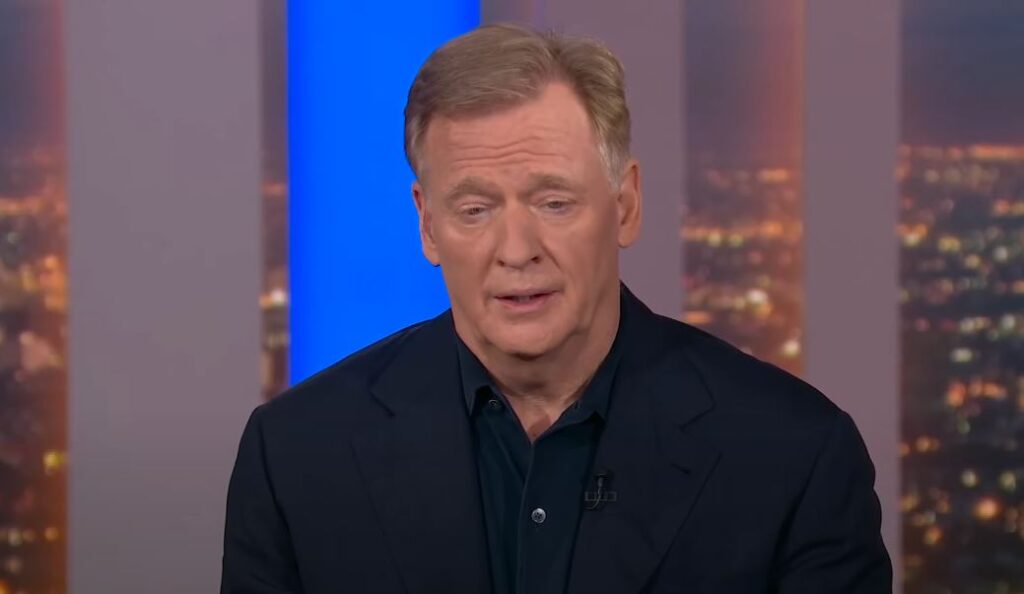
Roger Goodell’s wealth comes directly from leading the NFL into an unprecedented period of profitability, not from celebrity endorsements or ostentatious side projects. With an estimated net worth of $250 million to $300 million, he is a remarkable example of how one person can leverage institutional power to unite billionaire owners and a multibillion-dollar audience behind a single growth engine.
After submitting letters to each of the 28 league teams, he started out modestly in 1982 as an unpaid intern. The magnitude of his current compensation stands in stark contrast to that perseverance, which is especially inventive in its grassroots ambition. The NFL made roughly $6 billion a year when Goodell was elected commissioner in 2006. That amount has increased threefold during his tenure, approaching $20 billion, and his compensation package reflects this exponential growth.
Roger Goodell Net Worth – Bio Data and Career Information
| Category | Details |
|---|---|
| Full Name | Roger Stokoe Goodell |
| Date of Birth | February 19, 1959 |
| Birthplace | Jamestown, New York, U.S. |
| Nationality | American |
| Education | Washington & Jefferson College (B.A. Economics) |
| Occupation | Commissioner of the NFL (since 2006) |
| Spouse | Jane Skinner (m. 1997) |
| Children | 2 |
| Parents | Charles Goodell (former U.S. Senator) |
| Career Start | NFL administrative intern (1982) |
| Annual Compensation | About $64 million in recent years |
| Net Worth Estimate (2025) | $250–300 million |
| Contract Extension | Signed in 2024, runs until March 2027 |
| Major Achievements | Expanded league revenue from $6B to nearly $20B |
| Reference | Wikipedia – Roger Goodell (https://en.wikipedia.org/wiki/Roger_Goodell) |
His salary, which averages $64 million, has been set up with exceptional performance incentives in recent years. Media contracts, labor peace, and league expansion account for about 90% of his salary. Goodell made sure his fortune grew much more quickly than that of conventional media or sports executives by utilizing these metrics. Goodell’s structure is very obvious when contrasted with the tens of millions of dollars earned by Hollywood moguls like Bob Iger: if the league succeeds, so does he.
NFL owners, who see him as a strategist and a shield, have benefited most from this arrangement. While his decisions have drawn criticism, they have also significantly improved the NFL’s long-term standing. He has led them through crises like player safety lawsuits, Bountygate, Deflategate, and anthem protests that could have destabilized the league. Similar to Dana White of the UFC or Adam Silver of the NBA, Goodell has evolved into a cultural icon whose success is correlated with the institution’s overall health.
Another increase in personal wealth is all but guaranteed by his extension through 2027. With games in London, Frankfurt, and possibly Mexico City, the NFL is making a strong push into international markets. Goodell is anticipated to generate new revenue that will once more support his exorbitant salary. Through strategic alliances with international markets and broadcasters, that global expansion plan might eventually put his net worth closer to the half-billion dollar threshold.
Goodell’s upbringing has also had a significant influence on his financial path. Being the son of U.S. Senator Charles Goodell, he was raised surrounded by governance and negotiation. His preparation for the politics of sports, where billionaires and labor unions clash, was greatly aided by this influence. This ability was demonstrated during the 2011 lockout, when he led the league to a resolution that preserved its financial trajectory by acting more like a head of state than a sports commissioner.
His wealth highlights how executives are becoming more and more visible as quasi-celebrities in society. Fans used to argue over coaches and quarterbacks, but now they discuss Goodell’s pay on social media in addition to Beyoncé’s tour earnings or Elon Musk’s stock sales. In broader discussions about inequality, the commissioner’s income is frequently invoked as a symbol of how society is becoming more critical of wealth at the top. Nonetheless, Goodell continues to produce remarkably consistent financial results, much like tech CEOs, which accounts for the owners’ steadfast loyalty.
Critics contend that by managing the players’ labor, Goodell amasses generational wealth while they jeopardize their health for brief careers. In light of growing awareness of brain trauma and long-term health costs, this tension has become especially apparent. However, his steadfast pursuit of lucrative broadcasting rights, his willingness to enforce conduct policies, and his discipline are all seen by supporters as proof that he is worth every cent. Both viewpoints emphasize that his wealth is more than just a figure; rather, it represents the relationship between leadership and labor in the most profitable sport in America.
It’s instructive to compare it to the players themselves. Goodell’s $300 million fortune shows that commissioners can subtly compete with world-renowned players, even though Patrick Mahomes may have a $500 million contract and Cristiano Ronaldo has earned over half a billion dollars in his career. His attendance at owners’ meetings with people like Robert Kraft or Jerry Jones highlights his prominence; he is not a player, but he has influence over the decisions made by those who shape the game on the field. In the sports industry, this authority-to-wealth ratio is especially creative.
Goodell’s wealth acts as a mirror for society. It draws attention to the fact that in America, institutional guardianship, management, and negotiation are valued just as highly as athletic ability. His journey from intern to commissioner implies that, although privilege—his upbringing and early access—was important, perseverance and flexibility were just as important. His story is uplifting for those who view leadership as a craft rather than a show because of this duality.
